
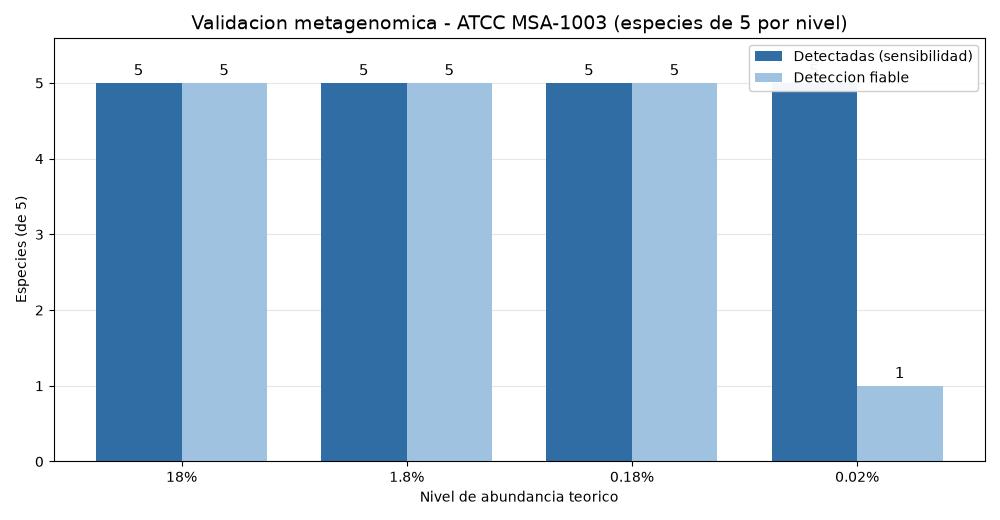
We have validated our metagenomics pipeline against the certified mock community ATCC MSA-1003, a mix of 20 bacterial strains arranged in a staggered design across four abundance tiers (18%, 1.8%, 0.18% and 0.02%). This gradient acts as a built-in ruler that calibrates the limit of detection directly, rather than estimating it.
Using read-based taxonomic profiling (Kraken2 + Bracken), detection sensitivity was 100%: every one of the 20 species produced a detectable signal, including the rarest strains at the 0.02% level.
To guarantee precise, reliable results, however, we apply a confidence threshold against the noise background. Down to the 0.18% tier every species is confirmed; in the lowest 0.02% theoretical tier only one of the five (Phocaeicola vulgatus) stands clearly above the noise and is reported as confidently detected. The reliable detection floor for this assay is ≈0.025%; fainter traces are reported honestly as “presence not confirmed”, pending orthogonal confirmation (marker-gene profiling or greater sequencing depth).
What this means for you
In metagenomics, the easy part is handing over an endless list of species. The valuable part is knowing which ones you can trust. Our pipeline doesn't just detect: it separates real signal from noise and tells you, species by species, how confidently you can act. That turns raw data into a decision you can defend before a client, a board or a regulator. And because every analysis is validated against certified reference material, with full traceability and a characterised limit of detection, we don't deliver pretty charts: we deliver results you can build on.