
Detecting who is in a sample is only half the story. The other half — the one that drives decisions — is knowing what they can do. Building on the genomes we reconstructed from the ATCC MSA-1003 reference community, we annotated their full functional gene catalogue.
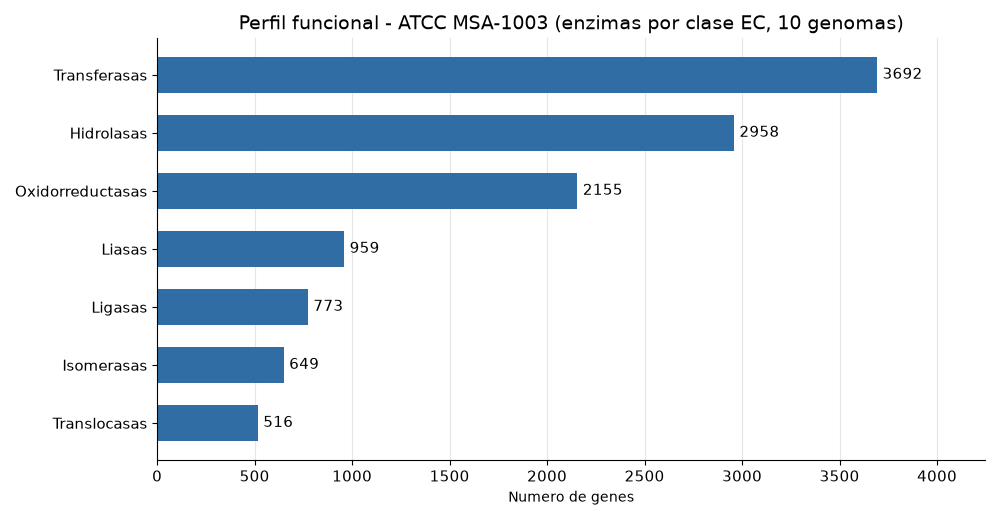
Across the 10 high-quality genomes we annotated 36,294 protein-coding genes, of which 59% carry an assigned biological function (the rest are hypothetical proteins, as expected in any bacterial genome). We classified 11,702 enzymes by EC class: transferases and hydrolases dominate, the signature of a metabolically versatile community geared for both biosynthesis and degradation.
Beyond core metabolism, every genome carries genes for membrane transport, together with signals related to antibiotic resistance, virulence and mobile genetic elements. These categories are predicted from the gene annotation and can be confirmed with curated databases (CARD/ResFinder for resistance, VFDB for virulence) as a dedicated module.
What this means for you
Functional annotation is what turns a species list into actionable biology. It answers the questions clients actually ask: can this community degrade my substrate, resist my antibiotic, produce my compound of interest? We don't just tell you who is there — we hand you the genomes, the genes and the functions behind them, ready to turn a microbial community into a decision.